Map

Thursday, October 7, 2010

Cusco, Arequipa & Colca Canyon

Before we carry on where we left off, we thought we'd throw in a couple pictures from Cusco... since we spent 4 days there and forgot to upload any pictures. It's bizarre that we didn't blog about it, because we actually really enjoyed the city. The main square (Plaza de Armas) has two huge cathedrals in it. We didn't venture into them though because we thought the price was a bit steep (~$12).


We spent the majority of one afternoon wandering through mazes of stairs trying to find our hostel.  We were fairly acclimatized by this point, but you could still feel the altitude if you climbed enough stairs (or were sick, as our poor friend Trine was).


This is not the first time we've seen this, but it's the first time Lisa managed to snag a picture. Here is one of those adorable, traditional women, peeing in the street gutter. No big deal in Peru, apparently.


We spent quite a bit of time just wandering the streets; the city has been around since pre-Inca time and Inca relics are everywhere. A lot of the walls and parts of buildings are still original Inca stone. Here is a view of the city from another Cathedral; you can see the Plaza de Armas in the middle. The very first time you see a traditionally dressed 6 year old carrying a lamb, you immediately grab your camera, because it is truly irresistibly cute. The parent will then magically appear and demand payment for the cute photo you just took. For that exact reason, you won't see any cute kid-lamb pictures here.


We spent an extra day in Cusco recouperating, then hopped on another night bus (not one of the better ones, unfortunately). We arrived early in the morning to Arequipa. The landscapes as seen from the night buses are often pretty spectacular, especially at sunrise and sunset.


Arequipa is a charming, clean and safe city. We were here for Peru national elections, which was a huge deal; way more so than elections in Canada. The celebrations were comparable to those following hockey games in Canada. For two days prior to elections (Friday, and Saturday) it is illegal to sell or consume alcohol in Peru (but no rules about celebrating the day of, or after...). Here is a shot in the Plaza de Armas in Arequipa.


We wandered around Arequipa and arranged a tour to the Colca Canyon for the following day. Wake-up call was at 2:45a.m. and we hopped on a bus at 3:30. Despite being pretty bundled, this was the coldest either of us have ever been on this whole trip. Apparently it's freezing at 4:00am at 4900 meters above sea level (the high of the pass on the way to the canyon). The cold, and the typical Peruvian driving manners prevented us from sleeping much, but we were suprisingly ready to go by the time we reached the canyons. We are getting used to the 3:00am wake-up thing. On the way to the Canyon we stopped to watch Andean Condors soaring above the Canyon on thermals. They are majestic birds with wingspans over 3 meters. They almost looked small in relation to the size of the Canyon, however.


We started our 4-hour descent down into the Canyon, followed by another hour back up the other side to our lunch spot. The trail was very dissimilar to the Inka Trail; scorching hot, dusty, steep and narrow. The lunch was fantastic considering the circumstances; it's amazing what you can do with a few fresh ingredients. Lisa got stung a few times by a nasty Andean wasp which got between her and her backback. It was definitely a wasp, despite the locals who told us (from looking at the bite) that it was certainly a scorpion sting.

We have been spoiled by good guides so far on this trip, so it was a sharp contrast between those guides and the one we got on this trip. We basically did our own thing, because our guide couldn't have been bothered to tell us about anything, or even lead the way for that matter. Not that the trail was particularly hard to find; there is only one trail into and out of the Canyon which serves as the only road for the 900 residents on the Canyon (spread out among numerous small villages). All food and supplies into and out of the Canyon go by mule or donkey.


We passed through 2 of the villages on our way. The main village boasts an elementary school and an abandonned church (for lack of a pastor). A lot of the homes are deserted because families are forced to leave the Canyon if their children want to continue their (non-mandatory) education beyond grade 6. There was also a lonely looking health clinic; the locals prefer to use traditional medicine (Shamans).


After lunch we descended back down into the bottom of the Canyon to the Oasis where we would spend the night.


We were tired and sweaty and jumped into the pool without a second thought. Unfortunately, our guide abandoned us (once again) and we spent a long, cold while treading water waiting for him to bring us keys for our huts. We eventually gave up and changed back into our dirty clothes in the outhouse washrooms.


The post-hike evening social atmosphere was not nearly as fun as it was on the Machu Picchu hike, but that was fine because we needed a good sleep anyways; we'd been up since 2:45am and had a 4:45am wake-up call to look forward to. The stars in the Canyon were unbelievable; probably the most stars we've ever seen. Our guide told us to meet at 4:50am, so naturally everyone in the group was on time, but we left at 5:1am when the guide (whose name we never knew) finally showed up. The sun rose as we hiked, but we were [thankfully] shaded most of the way. Here is a shot of us; in the background you can see the Oasis where we slept. This is about 1/3 of the way back up out of the canyon.


At the top we enjoyed a well-deserved breakfast. In general breakfasts here are pretty weak; mostly white bread and jam... not a great way to start a day of hiking. Even worse, there was NO breakfast before the 3-hour trek up, so we were so glad we had some goodies stashed in our packs to sustain us, because even with them were were starving when we reached the top. A lady at the top was selling bananas; best 1 sole (about 33cents) ever spent on a banana. Our guide dissapeared again at breakfast, so we wandered around Cobanaconda for awhile before catching the bus back. A small, quiet city, with lots of traditionally dressed women.


We stopped briefly on the way back to check out the extensive agricultural terracing in the valley. We also changed into cooler outfits, and noticed we were wearing exactly the same thing!


We also stopped at 4900 meters (16 100 feet - for reference, Calgary (one of the highest cities in Canada) is at 3440 feet) to view the many volcanoes in the area, including the famous El Misti. For miles, thousands of rock "scultpures" littered the tundra-esque landscape. They were originally made by locals as offerings, but now tourists have continued the "trend". If you look closely, you can see them in the backgroud below.


The landscapes in the National Park on the way back to Arequipa were surreal. Something between tundra and muskeg and desert. Llamas, alpacas and vicunas (the smaller, rarer relative of the former two, and the national animal of Peru) were plentiful.


Llamas


Vicunas
We carefully captured a shot of this classic sign out the back window of the bus; a true display of team effort if you could have been there to see it (our guide clearly was not going to stop to let us get the shot).

Safely back in Arequipa, at our sweet hostel (Wayna River Backpackers Hostel), we did our laundry. We are getting really resourceful with the laundry thing. Our clothes even had time to sun-dry before we hopped on another bus to Puno, on Lake Titicaca (where we are now). But more on that later... keep posted!

Sunday, October 3, 2010

Inka Trail to Machu Picchu


We survived the Inca Trail! We booked a 7-day tour through GAP Adventures many months ago, because permits for the Inca Trail book up months in advance. Only 500 permits are issued for every day, 200 of which are for hikers, and the remainder for guides, porters and cooks.

The first day of our tour was spent in the Sacred Valley near Cusco. We visited many ruins, including Sacsayhuaman (easily remembered by it's close pronunciation to "Sexy Woman") Pisac and Ollantaytambo. The landscape is still very desert-like in this part of Peru.


GAP adventures supports an eco-tourism community called Planetierra in the Sacred Valley. We visited the community, where women spin and dye their own alpaca wool ("baby" and "adult" wool), and weave tapestries and textiles using traditional methods. The wool below was dyed using a variety of local plants and minerals. We got to see each part of the process, and bought some sweet unique souvenirs!


We visited the Sunday market in Pisac too. Vendors littered the streets for blocks (with children and animals in tow) selling everything from powdered dyes, to potatoes, to textiles and batteries.


Our last stop was the town and ruins of Ollyntaytambo.


Peru national elections take place on Sunday, October 3rd (tomorrow, actually), and so we have been seeing politcal propaganda everywhere; even painted onto the sides of houses. Below is a group of locals carrying flags for their preferred political party through town. Evidence of the upcoming elections is literally everywhere (including increased bus fares!).


On day 2, we started the Inka Trail. Our group consisted of 16 hikers, 1 lead guide, 2 assistants (tail-guides), 2 cooks and 22 porters!


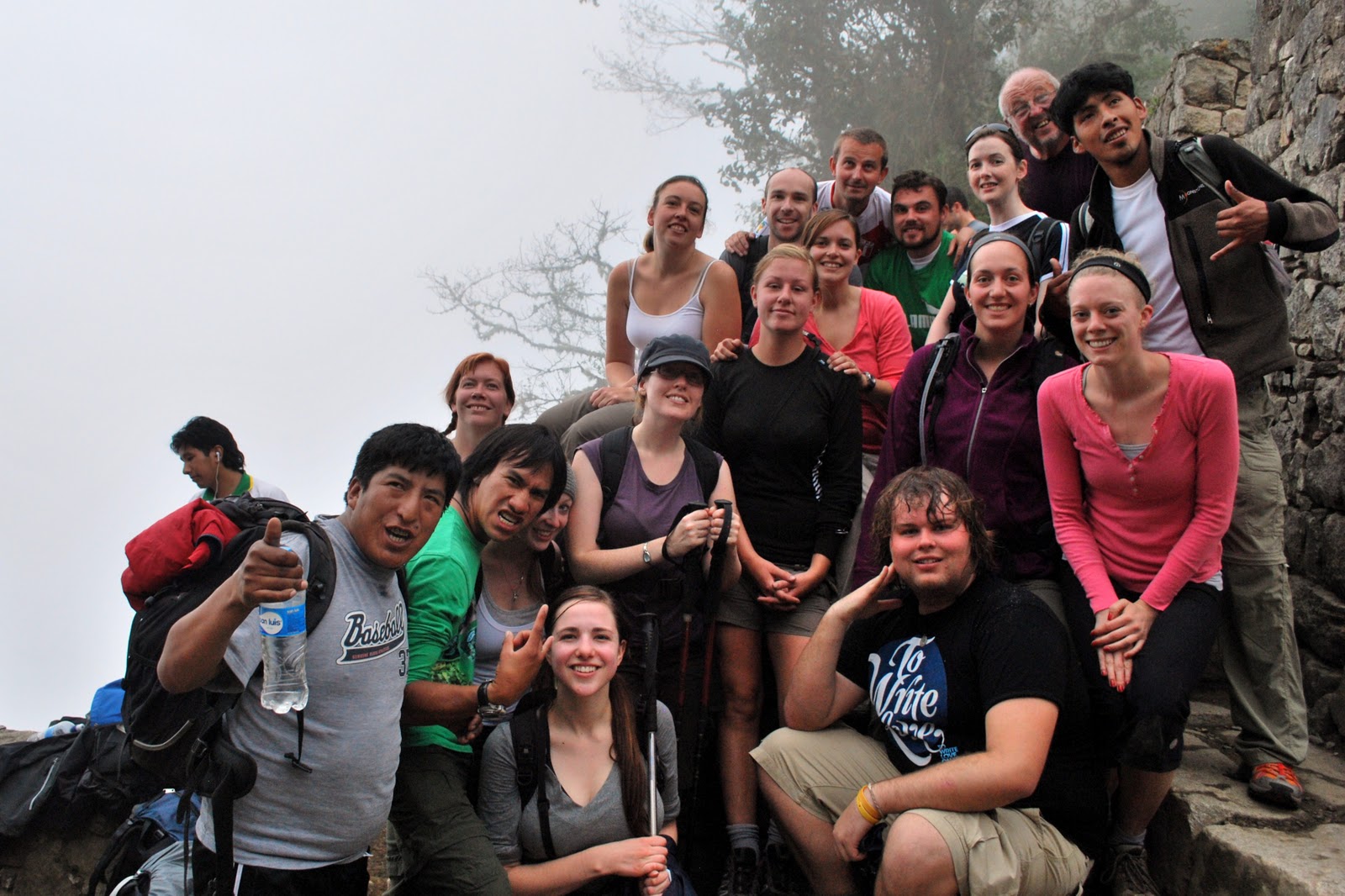
Most of our group was from Canada, the UK, Australia or New Zealand. Here's our eager pre-departure picture (still looking good!).


The early part of the trail took us through local farmlands where we encountered many local children and livestock (cows, llamas, pigs, dogs, ....). This pig photo is dedicated to Taryn (sorry, we tried to bring Rupert home for you but he was a bit wild and muddy).


The first day of the hike took us mostly along the Urubamba River valley, with some steep ascents (and descents) along the way. Our guide called this day the "training day" (a casual 7-hour hike).


At the end of the first day of trekking we arrived at our camp site, where the porters had kindly already set up our tents, and had snacks ready. We played cards and socialized with our group, before heading to bed at 8:00pm (!). To be fair, wake-up call for the next day was at 5:00am. We started each day our super early (in the dark) so that we had prime weather for hiking, and the trail mostly to ourselves. This also meant we finished hiking in the early/late afternoon everyday and had a good number of hours to "chill out" each evening.


The early morning light was also ideal for picture taking, as the valleys got hazy in the afternoons.


Day 2 of the trek "the challenging day" took us up to the top of Dead Woman's Pass; the highest point on the trip. It was a steady uphill from 6:00am until 11:00am, followed by a short break and then a steep 2-hour descent.


Here is a picture from the top of Dead Woman's Pass. As we descended the scenery changed rapidly into cloud forest.


On day 3 of the hike we woke up at 5:00 to a gorgeous view. We resumed hiking at 6:00am to tackle the steepest section of the trail before the weather got too hot.


Here is a picture of one of the steeper sections of stairs we climbed. Most of the 40km trail was built by the Incas from huge stones. It never looks as steep as it was when you look at the photos!


Over the 4 day hike we passed by numerous Inca ruins, where we usually stopped for water/snack breaks and a historical explanation by the guides.  In the photo below, you can see the steep stone staircase on the left leading up to the ruins.


Towards the end of the third day, the landscape became much more jungle-like. The humidity skyrocketed, and for a large part of the day we were hiking through cloud. The trail was narrow and carved into the side of the mountain. In the picture below it looks like the trail leads into a cave, but it did come out the other side!


We didn't see much wildlife, but there were lots of huge, "furry" moths, and we saw many birds, including this humminbird ("calibri" in spanish).


After lunch on the third day of hiking, there was a mad race for the final campsite, where we would be able to shower for the first time in 3 days. The final 6km descent to the campsite was a long, steep, downhill staircase, nick-named the "gringo-killer". We learnt that "gringo" isn't actually a derogatory term here (unlike in some places). Lisa was on a bit of an adrenaline kick and raced down behind the porters (made it to the bottom in 45 minutes!); managing to snag this picture on the way. Our porters (unlike those from some other groups) only carried the legal maximum of 25kg on their backs. We were told that despite laws, some cheaper travel agencies underpay and overload their porters. Despite the huge loads, they were super cheerful, and were laughing and joking as they ran down the mountain to the next camp.


At the final campsite, we all enjoyed hot (electric!) showers, cold (expensive) beer and a good company. We played our new favorite card game (called "shithead") pretty much non-stop until dinner every evening. The cooks even made us a cake to celebrate completing the bulk of the trip (only 6km left for the next morning).

We crawled into bed at the ridiculous hour of 7:00pm to try and catch a good sleep before the 3:00am wake-up call the next morning. It began pouring rain at about 2:45am and our first thoughts were that it was going to be a cold, wet, dark morning. Fortunately it stopped raining just before breakfast, and we the trail at 4:00am. The objective was to be the first group to the "checkpoint" and hence the first group to reach the Sungate (where we would be able see Machu Picchu at sunrise). We were indeed the first group at the checkpoint, but that meant we had an hour and a half to kill while we waited for the trail to open. The final stretch included a ridiculously steep set of stairs. Despite the fatigue, we all "gave 'er" and raced for the sungate.  Here it is!! Note: completely cloudy. We couldn't see Machu Picchu.  Got a great group shot though! We were really expecting to see sunrise over Machu Picchu but we should have taken the hints from our guide more seriously, who referred to the Sungate as the "Cloudgate" the whole 4 days.


We waited for the "lagger" (one in particular, haha) to catch up at the sungate then slowly headed down to Machu Picchu. There was really no rush now, because the entire site was covered in cloud, and it was 6:30am afterall. Our guide, Ali, let the assistant guides, JC and David lead the tour around Machu Picchu. We were hoping to climb Wayna Picchu (the iconic peak in the background) but it was impossible for Inca-trailers, since only 400 tickets are given out every day, and the lazy people who take bus up from Aguas Caliente at 5:30 (and those who did the alternative Lares trek)  snag all the tickets. We could have climbed Machu Picchu mountain (behind the site) but partially because the views were clouded over, and partially because our legs were really dead, we opted out. Luckily, at 7 in the morning, we had the ruins nearly to ourselves (or relatively speaking, considering it's Machu Picchu, and ~1000 people visit it every day).  The light wasn't great for taking pictures, but it was neat to get pictures with so few tourists in them, and just to see the magnificent site in general.


The terraces below were used for agriculture, whereas some of the terraces on the other side of the site were mainly for structural support and decoration. Because of the steep grade of the mountain, the terraces made agriculture possible; without them, rain would simply wash down the slope, and mudslides would have been inevitable.


Here is a picture of our friend, Jo Leek (from the UK), poking her head out through one of many huge stone doorways (this one in particular lead to a bedroom).


Here we are! It felt great to be here.


After we'd explored the site we took a bus down to Aguas Caliente and enjoyed little luxuries; an unbelievable meal at Indio Feliz restuarant (recommendation courtesy of some fellow travellers), and washrooms complete with toilet seats, toilet paper, and hand soap.. wow!

This is the token halarious picture of the post.  We weren't on the bus when this happened; but, apparently this lady sat down on the very last seat on the bus between Les (from New Zealand) and Mark (ex-pat Australian who just spent 3 years in Toronto) (two fellow Inca trail hikers) and this was her look for the entire 30 minute ride down.  She was pretending to sleep I guess, but was really covering her nose from the undeniable scent of two men who have just spent four days hiking.  Mark is kindly wafting the scent her way! Photo credit: Matt Leek.

We took the train back to Cusco that evening (had an entire train car full of GAP travellers, so naturally most of the group drank beer and played cards). For reasons unknown, we thought it was a smart idea to go out and celebrate that night (stay up for a full 24 hours). Chris, our friend from the UK, snagged this picture in the men's washroom at the bar. Make what you will of it.


We spent two days recuperating in Cusco, since we were both fighting a cold or flu of sorts, and some serious fatigue. We bravely tried Cuy (Guinea Pig) and Alpaca meat (local specialities); conveniently desguised as Cuy in spicy peanut sauce and stewed alpaca in a creamy spinach sauce. We'll put pictures up at some point, but they aren't on our camera. Sam (another friend from the UK) ordered Cuy al Forno (entire grilled guinea pig, spicy pepper in mouth and all). It was interesting! We are now in Arequipa. Keep posted for our next adventures; Colca Canyon! (One of the deepest in the world). We are heading out now to set up our next treking adventure. Keep the comments coming!