Only about 5% of roads in Bolivia are paved. The reality of this really hit home on our first night bus in Bolvia, from La Paz to Uyuni. The bus left at 9pm, and the driver assistant advised us to try and sleep for the first few hours, before we hit the bumpy dirt roads. We're not sure the "roads" were even really roads... more of rutted paths through the desert. We were due to arrive around 7:00, but by now we've learnt this means 9:00, so we arrived around then, met our guide, found Dewey, loaded our gear on top of the jeep, and had some breakfast. Our guide, Archie, and driver, Carmelo, went to buy an iPOD cord from the market while we ate breakfast, and we all took this is a really good sign of the good times to be had on the next four days of our trip. We set out and first visisted the "train graveyard", a collection of old, rusty trains abandonned (and now considered to be a historical site) from war times.

From there, we headed out into the vast expanse of the Salar de Uyuni. The salt flats, which cover an area of 12 106 squared kilometers, are the evaporated remains of an old lake. For as far as the eye can see, there is bright, white, salt, with volcanoes in the distance. During parts of the year, the flats are flooded, and innavigable due to zero visibility from the reflections. We stopped for lunch, and took a silly amount of photos, taking advantage of the illusions created by the white expanse of salt and bright, cloudless blue sky.


Up close, you can see that the salt has dried in hexagonical shapes, and you could break free large chunks of salt, and lick them (if you wanted). We also stopped at some thermal pools, where chemicals (including lithium) bubbled to the surface. For those who have visited Yellowstone National Park in Wyoming, you would notice the striking similarity (other than the salt, of course). There are "islands" in the middle of the salt flats and after many hours of driving, we stopped as Isla del Pescado (a.k.a. Isla Incahuasi), a cactus-covered island in the middle of the sea of salt. We wandered around the island, with it's many 1000+ year old cacti, and bizarre rock formations.

Mirages and illusions made the whole place seem surreal, and was easy to see how you could easily get lost in the desert, especially if the salt plains were flooded.

We spent the night at a Salt "Hotel" near San Juan; entirely carved out of blocks of salt (including the picnic tables, and beds). In these remote Bolivian communities, electricity is a rarity, and only available from 7:00 to 10:00pm. We were told that showering wasn't going to be an option during the 4-day tour, so when we were offered hot showers for 10BS (about $1.50... expensive for here) we leapt on the opportunity.

The next morning was Lisa's 23rd birthday. We woke up at 5:30, packed our bags and gear back on top of the jeep, and enjoyed white breakfast bundt cake, complete with a candle in the center! We left the salt flats (driving past many vicuna along the way) and the scenery changed remarkably.

There aren't any real roads through the Bolivian desert, but it was navigable by Jeep. We stopped in a remote community to buy some wine and snacks, and played a little football with the local kids.

We were very close to the Chilean and Argenitian borders at this point, and passed through a couple military community check points. Volcanoes, smaller salt flats, llamas and vicunas were regular sightings from the Jeep.

We stopped to observe one of the only active volcanoes in the region. If you look closely, you can see a small puff of smoke coming out the left side of the volcano below.

After being cramped up in the Jeep for hours, we felt some mid-morning stretches were necessary.

In the afternoon we saw many colorful lagoons: Laguna Canapa, Laguna Hedionda, Laguna Charcota, Laguna Honda, Laguna Ramaditas and Laguna Colorada.


Each lagoon was a unique color, and most were home to huge flocks of flamingos; one of the only species able to survive in the salty, inhospitable landscape. We saw three different species of flamingo.


In all, we probably spent about 8 or 10 hours in the Jeep, but with great company, great tunes, and great landscapes, the time flew by. Our last stop of the day was some seemingly out of place rock formations in the middle of the desert which were shaped by winds and blowing sand.
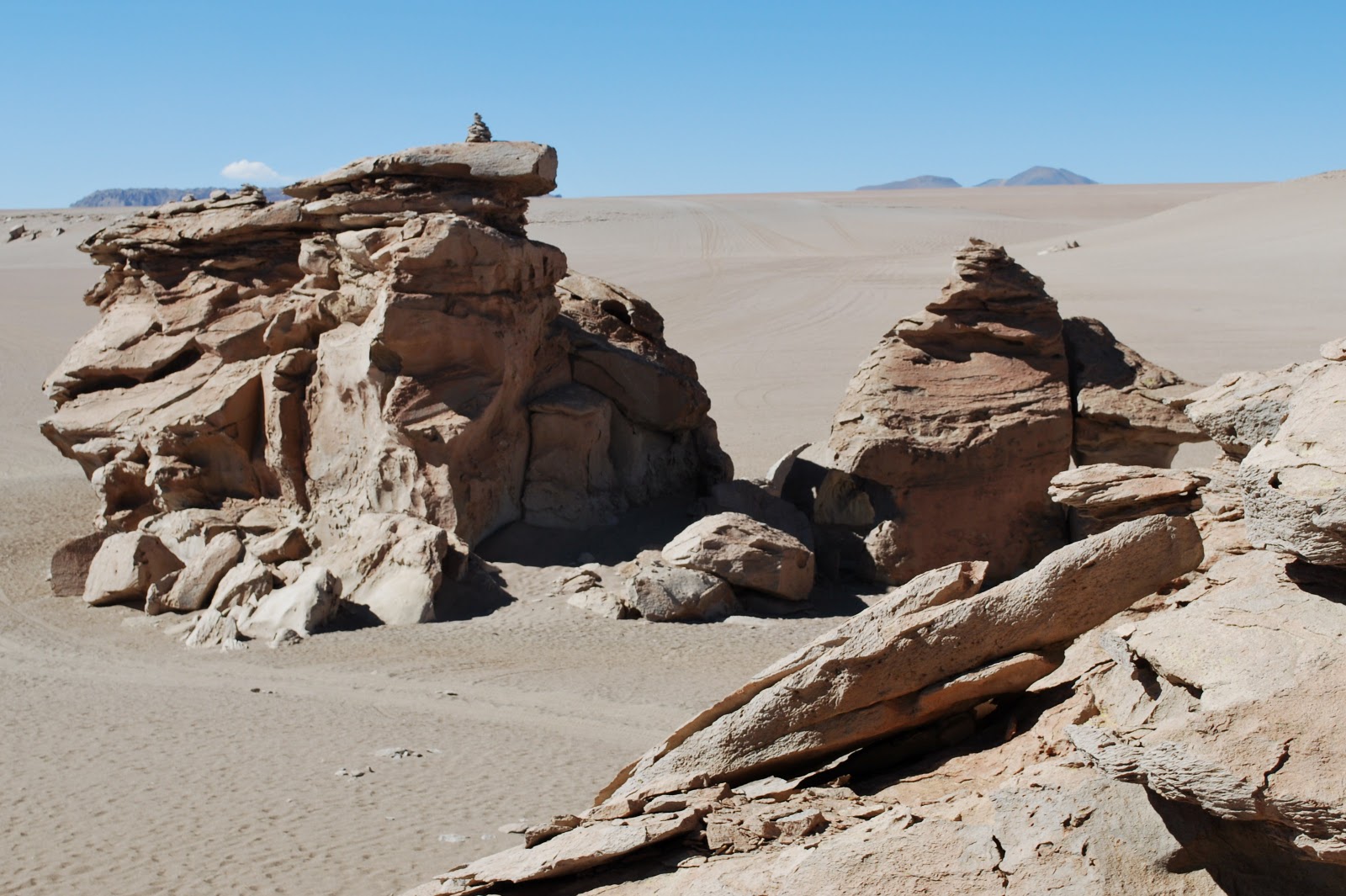
They provided some absolutely incredible bouldering (rock-climbing) opportunities and we all climbed around on the rocks for far longer than our driver and guide would probably have liked.


All in all, there were probably about 100 rocks formations, many as large as 2 or 3-story houses. The most famous of the rock formations was the Arbol de Piedra ("Tree of Rock").

That night we sipped wine, ate Bolivian food, and played cards... all while well bundled up at 4300 meters (quite chilly!). A pretty great way to spend a birthday!
On day 3, we woke up early again visisted geysers, thermal pools, and some natural hot springs (where we bravely took a dip at 7:00am). It stunk like sulphur, and the stinky mist covered us all.


After breakfast, it was a long day in Jeep, but the scenery was extraordinary, and we sang (much to the amusement of our guide and driver) pretty much the whole way (all the good stuff: Journey, Kelly Clarkson, good Canadian country, 90's one-hit wonders... too many to name).


The mountain range below is actually on the border between Bolivia and Chile.


Later in the day we stopped at Laguna Verde ("Green Lagoon"); one of the most famous lagoons in Bolivia. Unfortunately, it wasn't very green when we were there... apparently it changes throughout the day, depending on the sun. We had a good stretch, and made some rock towers instead.

The volcano behind Laguna Verde is a popular climbing destination. It's steady grade makes it easier than other volcanoes in the region. With binoculars you could see people climbing in the distance. The climb takes 8 hours up, and 3 down (due to the high altitude.. over 6000 meters above sea level).

We got really lucky at one lagoon, and spotted vicuna and flamingos in the same area... perfect photo opportunity! The white in the background is salt.

The scenery changed once again as we lost elevation.

We stopped for lunch in a small community, and played soccer with the local kids. They were facinated by the camera, and enjoyed chatting to us (although we didn't understand everything they were saying). They were telling us they had "Yamitas" in the house... which we later found out were "Llamitas", a.k.a. baby llamas.

As the Jeep slowly crawled up the hill on the other side of the valley, we saw a large dust-devil/ mini tornado going dangerously close to the town soon after we left.

Our last stop of the day was a abandonned town. It was destroyed by the Spanish about 300 years ago, and most of the inhabitants moved down the valley to another small town (whose name we forget) where we ended up spending the night.


We saw many of these rabbit/chinchila-like creatures running around the ruins. We'll have to double check, but we believe they are called Viscachas. Later, we found them on a menu in Potosi and bravely ordered them in a spicy sauce. It was quite good, although a bit difficult to pick all the meat off the bones!

At our accomodations that night, we stayed in a bedroom so full of beds you could barely get around. You had choice between a rock hard bed, and one which was all springs and no padding. We were tired though, we slept fine.

The woman whose house the accomodations were in was blind, but you'd never know it. She raised llamas and other animals (pictured below with our guide Archie).

On our very last day of the tour, we tried to see some wild ostrich, but were unsuccessful. Instead, our guide stopped at an abandoned copper mine and let us wander around (you'd NEVER get to do this in Canada). It was really interesting. The blue mineral in the rocks is the unrefined copper.


We stopped in another small village for lunch, and some local children brought out a brand new baby goat for us to hold.


We saw a brand new baby llama and it's mother, and vultures soaring around looking for the afterbirth.

We began our descent into Tupiza, known as red-rock country due to the iron deposits. This is where Butch Cassidy and Sundance Kid supposedly met their fate.

Below is the valley of the moon, just outside of Tupiza. Erosion created the spindly rock spires you can see below.

We ended our trip in Tupiza. Another great South American adventure!

