Map

Thursday, November 4, 2010

Tafi del Valle & Tucuman

One unfortunate thing about Argentina is that bus prices have about quadrupled. In Ecuador, Peru and Bolivia we were paying about $0.50-$1.00 (Cdn) per hour, and here it is about $2.50-$5.00 per hour. Although at least 8 hours on a bus actually gets you somewhere, since the roads are paved!

We took a bus from Cafayate to Tafi del Valle, and were surprised when we arrived after 2.5 hours (the book said 4-5). Tafi is tiny, pleasant village in the foothills of the Andes, known for it's beautiful setting and it's cheese. There isn´t any snow at this time of year, but the area is a big ski region in the winter.

We were really quite excited for the cheese situation, so that evening (during 5:00pm tea time) we ordered a cheese and charcuterie platter. It wasn't quite European quality (or Canadian for that matter) but then we can't really complain because it was leaps and bounds better than Bolivian cheese. The goat cheese had this bizarre spongy texture, and the ham was akin to the cheap type you'd get in a plastic package. We have to give the Argentines credit for their procuitto (after all, red meat it their specialty) and of course, the olives were tasty. In hindsight, ordering a cheese platter in northern Argentina was probably a questionable decision, but we tried!


The stray dogs in Argentina are as friendly as anywhere, but much much better fed, and far less mangy. In fact, they don't really look like strays anymore, but are just as abundant, and still sleep in the streets. They follow you around everywhere, and for no apparent reason because they don't beg. Here is unusual sighting; a stray mule eating out of a public garbage bin, and a dog picking up the rejected bits.


We had a bit of a walk from the bus station in Tafi to our planned hostel, and Lisa's pack has really taken a turn for the worst, so when a bubbly older lady stopped us on the street and asked us if we wanted to rent her $15 (Cdn) per night private apartment, complete with kitchenette, private bathroom, electric shower and two beds, we couldn't say no. It was adorable, and the family was so hospitable. (Her name is Alba, and her house is behind Mauro Artesanales, a couple blocks from the bus station... we promised her we'd tell our friends).


We made a wonderful pasta primavera, and sipped malbec.


We've been eating these for weeks, but keep forgetting to take a picture. The top parcel is a tamale, and the bottom one an humita. Both are cornmeal concoctions steamed in a corn husk parcel. Tamales generally have meat, and humitas have cheese, but everywhere they are slightly different, and equally wonderful.


The next day we wandered around town and took a leisurely stroll up to Mirador Loma del Cruz, up on the hill overlooking Tafi.


Another regional specialty is chivito (goat). We decided to try it out at Parrilla Don Pepino. There is not much meat on a goat. We decided it tasted somewhat comparable to a combination of pork and dark poultry meat, but it was tasty enough. Here are some goats on spits. The two of us shared half a goat, which was really just two small leg pieces and a small shoulder.


We said goodbye to Alba and headed for Tucuman to arrange a night bus to Cordoba. We arrived in Tucuman around 4:30 and booked a night bus for 10:40 so we headed for the central plaza to explore a bit in the meantime. Naturally, we had gelato (again). Not all prices in Argentina are crazy... this gigantic chocolate-dipped-waffle cone with nuts and two flavors of gelato cost us a whole $1.25CDN. Ice cream cones here come with a spoon, perhaps it is rude to lick. This was essentially our dinner, but we later supplemented with some fresh veggies and dried fruit from the market.


Tuesday, November 2, 2010

Let the Argentina Adventure Begin: Salta and Cafayate!

Reflecting upon our time in Bolivia, some of our favourite things were the unbelievable landscapes, the traditionally dressed women, how inexpensive everything was, the local culinary specialities (saltenas, sonsos, humitas and tamales, quinoa soup, grilled alpaca), the traditional culture, being the only white people on the buses (and feeling like we were really travelling), and how cities seemed to thrive in places which really shouldn't support life (i.e. middle of the desert or 4000 meters above sea level). Things we won't miss? The buses, the lack of WIFI internet and the disinterested attempt at directions that we'd get when we asked locals.

We excitedly took our LAST night bus in Bolvia from Potosi to Villazon, a town on the border between Bolivia and Argentina. As Bolivian night buses go, it was terrible. We slept almost nothing, and were seated in the back row, so the seats didn't recline at all, and every bump was exagerated. We literally got bumped out of our seats on more than one occasion. We never put out daypacks up on the luggage racks for safety reasons (anyone will tell you this is asking for them to get snatched), but for sake of a bit of leg room, we put our bag of food up there, and at one point during the night it flew to the front of the bus. Luckily, it was later found. We would have been very sad to lose our coveted box of multi-grain cheerios (our only break from white-bread breakfasts) which we'd been packing around since Tarija. From Villazon we had to walk a couple kilometers across the border to the bus station in La Quiaca. Unfortunately, the other strap on Lisa's pack broke at this point (the first one being wired onto the pack and duct-taped already). We caught another bus from La Quiaca to Salta, and were told it was direct, but we had a layover and bus-change in San Salvador de Jujuy. We thought we had a few hours to kill, so we wandered off to a cafe for some lunch, but then noticed that the clock said it was an hour later than we thought it was... oops... time change! We rushed back to the station only to find out that our bus was an hour later than the guy originally told us. We had crackers and juice for lunch instead. We got into Salta around 6, nearly 22 hours after leaving Potosi, and checked into Hostel Backpackers Salta; a cute joint with swimming pool and bar. Our $8US-a-night hostel even came with free dinner... empanadas! The only catch was that dinner was served on Argentinian time... meaning 10:30pm. Alex had a nasty migrane and went to bed, while Dewey and Lisa went on a mission for food to tide us over and ended up with "Super Ponchos" and Argentinian Gelato (nothing else was open at this time). For those who are wondering, a Super Poncho is an ubiquitous Argentinian specialty which is basically a huge hotdog, topped with corn niblets, spicy salsa and tiny potato chips resembling hickory sticks. You could also load it up with mayo, mustard and ketchup if you desired (we didn't). Argentinians know how to do Gelato! It's unreal. [we might have had gelato every day while we were in Salta... the boys in the store laughed at us].

As soon as we crossed the border into Argentina the people and the atmosphere changed dramatically (but not the landscape). People here are SO friendly and outgoing, and genuinely seem to like tourists (you can't say this about your average Bolivian). Hostels have kitchens again, and good steak is abundant and cheap. The fashion and the architecture is extremely European, and everything is a little bit cleaner. Poverty isn't as noticeable and prices on just about everything are at least double what they were in Bolivia. The whistling and cat-calls on the street have returned, after a much-enjoyed break from them while we were in Bolivia. The elevation has dropped significantly (back down to ~1500M) and with it, the temperatures have risen dramatically (our second day in Salta was well above 30 degrees).


We switched from eating out every meal, to cooking most of our meals. In Ecuador, Peru and Bolivia, eating out was SO inexpensive, and hostel kitchens so rare, that it only made sense to eat out. You couldn't save much money by self-catering. In Argentina however, the markets and grocery stores are wonderful, and every hostel has a kitchen. As well, eating out (while still cheap in comparison to Canada) is less afordable. We've been enjoying fresh stir-frys, vegetables from the market, whole-wheat bread and pasta, humitas and tamales, and grilled steak. We've also enjoyed being able to make oatmeal for breakfast instead of the usual white bread, butter, jam and dulce de leche (a sweet caramel concoction).


Even though we spent 3 days in Salta, we have very little photo evidence of our time there. We spent much of the second day recovering from our travels, doing laundry by hand (and drying it in the hot sun), and hanging out by the pool. The next day we hiked the 1100 steps up to El Mirador, a viewpoint of the city. We enjoyed getting humitas and tamales for breakfast at the central market every morning (to get our fix before these regional specialties are gone), and gelato at "tea-time" (6:00pm). We cooked lovely meals from Argentinian ingredients that we picked up from the market, and went out on the town one night.


On the 31st, we took a bus to Cafayate (population = 12,000), a small wine region in Argentina. Halloween isn't very prevalent here, but we saw a couple little kids dressed up and doing door-to-door.

On the morning of November the 1st, we enjoyed a free wine-tour given by our hostel to two local wineries (including fresh goat cheese - Queso de Cabra). The cheese was much appreciated since cheese has been rather bland, flavorless and rubbery for the first two months of our trip. We visited La Vasija Secreta winery and Bodega Domingo Hermanos. At both wineries we tried Torrontes. Suprisingly, both tasted quite different; the first was very dry, and the second a bit sweeter. We enjoyed the Domingo version better, and think we will keep sampling Torrontes to find our favorite. At Vasija we also tried a Malbec (which was OK) and at Domingo a Tannat (which we both disliked).

Bodega Vasija Secreta


Our photo-wine-rating system (we´ve since decided to switch to a ¨5 fingers¨ system to be more descriptive)
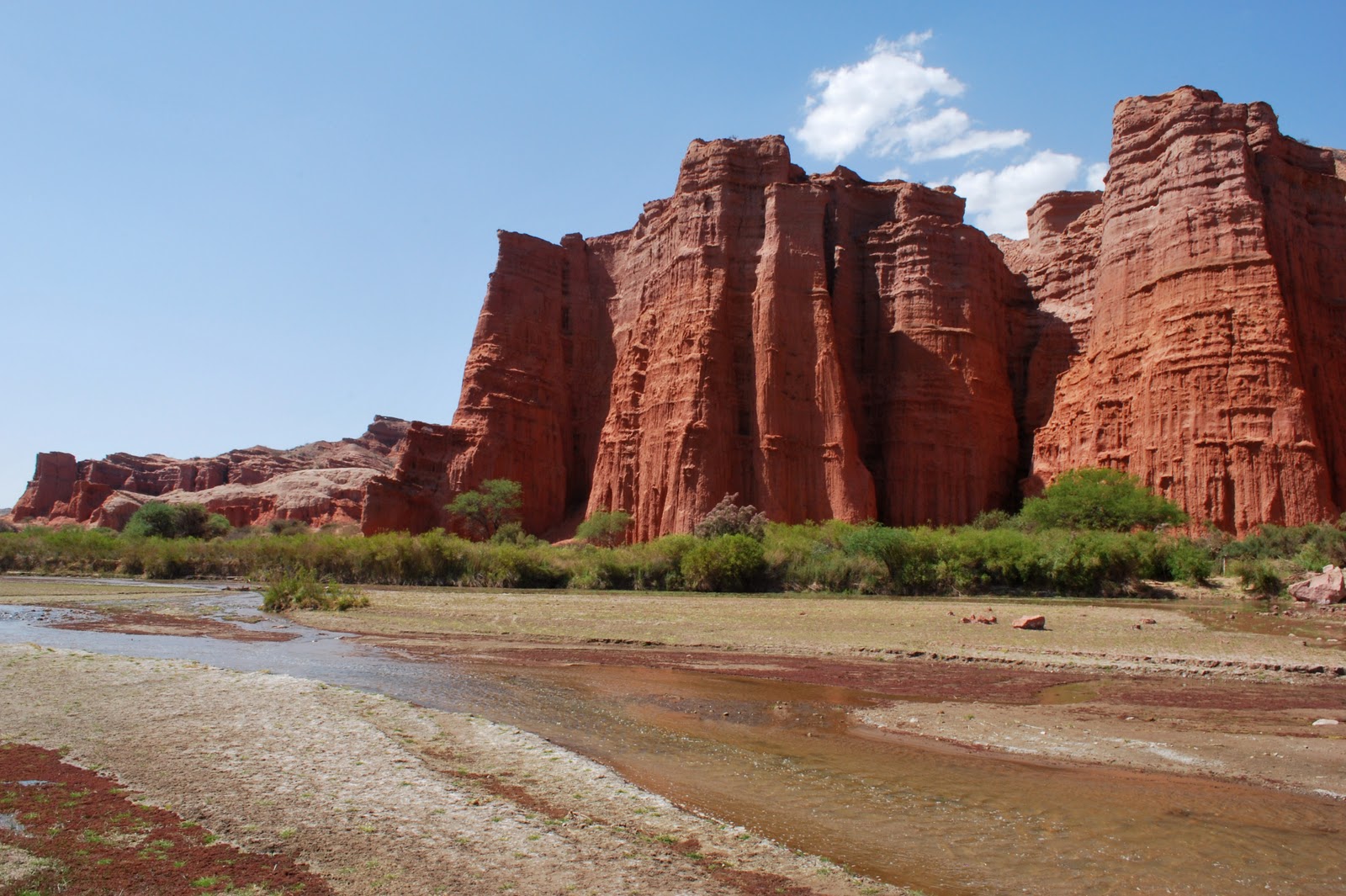
That afternoon we went on a tour of the nearby 80km-long canyon Quebrada de Cafayate (a.k.a. Quebrada de las Conchas) in the CalchaquĆ­ Valley. We visited famous formations such as El Obelisco, Los Castillos (the castles), La Garganta del Diablo (the throat of the devil), El Anfiteatro (the ampitheater), el Sapo (the frog), and the mountain of 17 colors. We saw 48 kilometers of the spectacular sceenery, stopped along the way to hike around in the landscape. We took lots of pictures!

This rock formation is supposed to look like a train. Can you see it?


Los Castillos and el Rio Colorada
The 5 distinct colours in the rock are due to oxidation of copper (blue), sulphur (yellow), zinc (brown), iron (red), and cobalt (green).


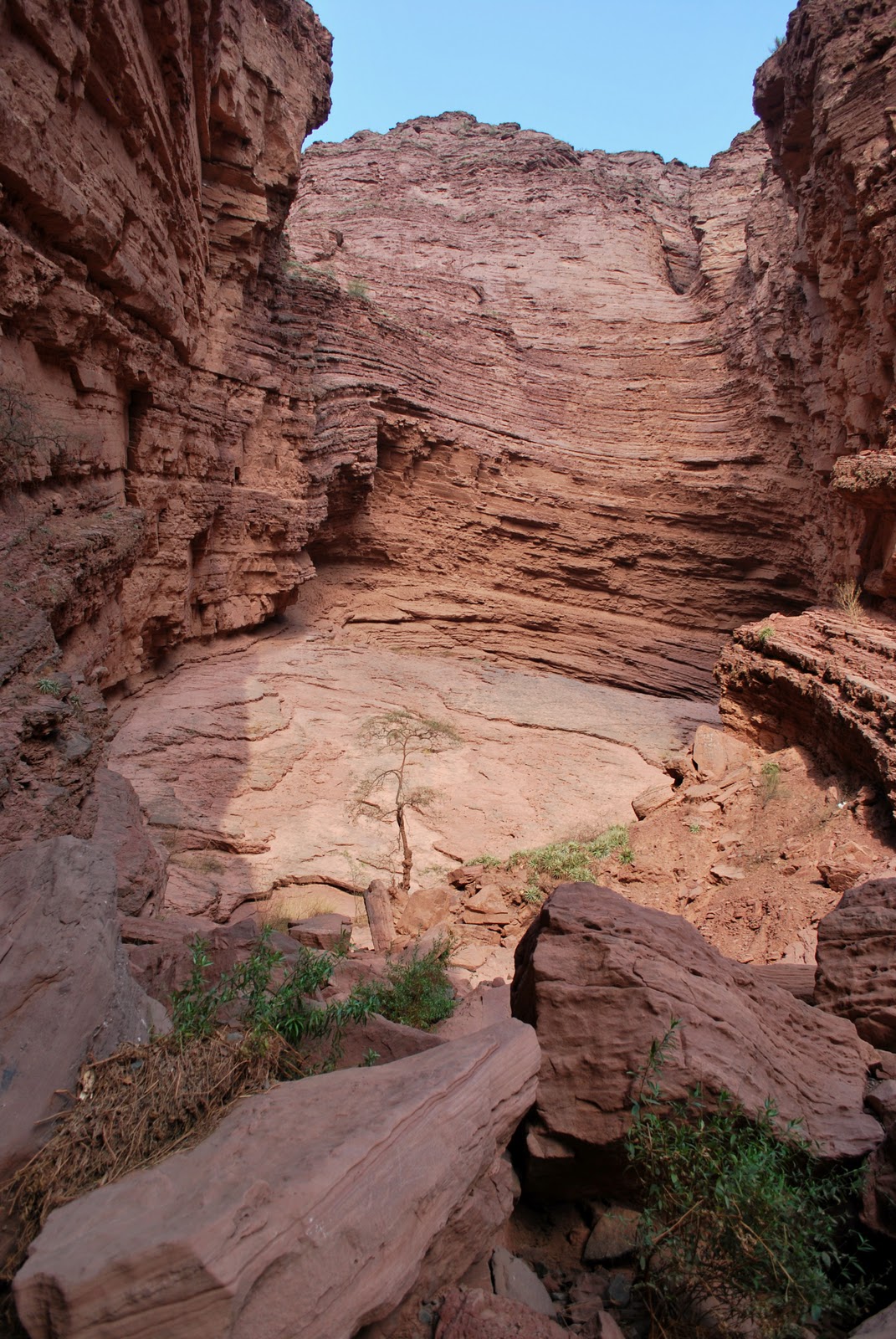
The acoustics in El Anfiteatro were fabulous. Apparently some famous Orchestra played in here once. If you look closely, you can see Alexandra standing at the bottom (to give you a sense of scale). It was an enormous hole (for which a wide angle or fish-eye lens would have done more justice)!


Below is a picture facing the other way from El Anfiteatro.


This is the Garganta del Diablo. We scaled up the flattish wall you can see behind the tree in the center to get the illusion photos below.


From Cafayate we took a short bus to Tafi del Valle, where we are now! Look, we are all caught up on the blog!! Whooo.

Sunday, October 31, 2010

Potosi Silver Mines

We were hoping to get this post up tonight when we got to Cafayate, but after arriving at the bus station for our 3:00pm we found out it was actually a 5:00pm bus.  We were bummed out until we found a power outlet and free wifi! As an added bonus terminals in Argentina are safe in comparison to any of the previous places we have been.  There is even a pharmacy, which is handy as we have been passing back and forth a very inconvenient sinus cold.

After Sucre we headed back to Potosi and arranged a tour of a silver mine on Cerro Rico for the next morning.  The tours are led by ex-miners and you visit working mines so you are able see the working conditions in the mines.  We were told that conditions haven't changed much in the past 400 years.  Initially we were hesitant to go into the mines for a few reasons.  Our guide book didn't fail to point out all the dangers and unpleasantries of the mines.  After spending some time in Potosi, watching a documentary (The Devil's Miner), talking to other travellers, and Dewey's persistance we figured it would be an experience we couldn't miss.


We "suited up" (protective suits, boots, hard hats, and lamps) and took a micro bus up to the Miner's Market.  There we were instructed to buy gifts for the miners; dynamite, nitroglycerin, fuses, and detonators.  Potosi is one of the only places in the world where anyone can buy dynamite legally, on the street without a license.  Other gifts included; coca leaves, chewable alkali, 96% pure alcohol, unfiltered cigarettes, and juice.  The miners chew up to a bag of coca leaves a day while in the mines to as it supposedly works to fight hunger, filter dust, and maintain alertness.  The alkali help release the alkaloids from the coca leaves. The alcohol is used both as an intoxicant and as an offering to El Tio (the God of the mines). Lisa had a problem with buying cigarettes and alcohol for the miners so we bought dynamite, juice, and coca instead. You had to buy at least some of these items in order to go on the mine tour and throughout the tour we handed these out to working miners that we passed in the tunnels.


We were invited to take a sip of the 96% alcohol.  Alex decided to give it a try and it basically evaporated (probably for the better) upon contact.  Note the Canada Dry label above!?


The miners don't work on salary, so their earnings depend on what minerals they can find and their quality.  They are responsible for buying all of their own supplies and as a result our gifts of dynamite were greatly appreciated.  We were also told that theft is very prevelant in the mines and often miners will find themselves working for a week just to afford new equipment. 


The trolley below weights around 1 tonne and the two miners in the back are the man power and the miner in the front steers.


According to our guide book, "Work is done mostly by hand with basic tools, and underground tmeratures vary from below freezing to a stifling 45 degrees Celcius.  Miners, exposed to myriad noxious chemicals, often die of silicosis pneumonia within 10 years of entering the mines". Unfortunately, over 800 children (mostly from families without a father) still work in the mines.  Women are not allowed to work in the mines as it is cosidered bad luck, but many women are employed to guard the tools outside the mines. The walls of the tunnels were covered with asbestos and arsenic. When we asked our guide why the miners don't wear masks he said that chewing coca and smoking cigarettes prevents the toxins from entering the miners lungs (??).


As a result of the dangers, many men nowadays only work in the mines for a couple of years.  The less fortunate are obliged to keep working in order to make a living. 


The miners believe that God can't help them in the mines and therefore they worship El Tio.  There is at least one Tio in each mine and hundered of independent mines tunnel through the mountain. Mines often stretch for around 14km and can have as many as 16 levels. The mines often intersect each other if they are following the same mineral vein.  Miners feel obligated to make generous offering to El Tio to keep them safe while they are in the mines.  You can see coca leaves, cigarettes, and full alcohol bottles scattered around El Tio.  Worshiping El Tio is believed to aid fertility.


The quality of the photos is poor since the tunnels were dark and dusty and it would have been foolish to bring the Nikon.  We thought a good alternative was Lisa's drop-proof, water-proof, point and shoot.  We were in the mines for about two hours and explored the first three levels.  To change levels you had to descend ladders through steep dark holes.  Our guide cautioned us not to wiggle the ladders too much or look up since falling rocks were not uncommon.  At one point one of the miners set off some dynamite on the path that was also our only exit and we waited around the corner for the blast.  You could definitely feel it!


This video is of us squeezing (literally) through a small hole between levels.  There is only one exit to the mine, so everywhere we went down we knew were coming back up.


Overall, the whole experience (while it may not have been comfortable) was very eye-opening and educational.  We will definitely think twice before complaing about work conditions in Canada.

Saturday, October 30, 2010

Tupiza, Tarija, Potosi and Sucre

Comments, people, comments!!! Please :D

How to leave a comment: At the bottom of each post, there is a little blue text display which says "0 comments" or "1 comment" or something along those lines. Click on it. It will bring you to a page with a blank text box. You don't have to make an account or anything, just leave a comment as "anonymous" if you'd like, and sign your name in the text box.

Our 4-day desert Jeep adventure ended in Tupiza. We stayed in the Annex of hotel Mitru, which was a cheaper option, but still allowed us to use their pool... so we spent a good day doing laundry, lounging by the pool and exploring Tupiza. The market in Tupiza was a dark maze of little tin stalls, selling everything imaginable. We bought some snacks and wire to fix Lisa's pack (the strap broke!).

The next day, Kayleigh and Russ rented some horses and a guide to explore the nearby Cayon del Inca, but ourselves and Dewey opted for the D.I.Y. route and just followed the horse prints out of town and up to the canyon.  


We saw the famous Devil's gate, and climbed around  a bit on it.


People on horseback could only make it so far up the canyon, where you encountered a fairly vertical rock face. We stopped here for lunch (the classic: tuna, bread, apples) then decided to see how far up the Canyon we could get. It was a fun hike up the cayon, with a few places where we got to do some good bouldering. 


The hike up the canyon wasn't a marked trail, and we did a fair bit of guesswork as to where we were going. You can't say we were lost, because there wasn't really a route to begin with. We were hoping to come out the other side of the canyon, but after trying two different routes, gave up and went back the way we came in.

Going down bouldering routes is often more challenging than finding a way up...


After Tupiza we all took a night bus to Tarija, the main city in Bolivia's wine region. The two cities look very close on a map, but the bus was scheduled to take 10 hours. This should have been some indication to the quality of the road... and it was. Another unpaved, switchback, single track road... in the fog. The bus was beyond basic, and we got bumped around pretty good (what can you expect for $5?). At some point in the middle of the night we woke up and realized we were stopped, and had been for a good couple hours (hence why we were actually asleep). It was just begining to get light out, and we could see that there were other buses and trucks stopped in front and behind us, but couldn't figure out what was going on. We never really did figure out what was going on, but it was possibly a truck strike (a few weeks earlier, bus drivers in Bolivia had striked for 3 days because a new law had been passed making it illegal for bus drivers to drink and drive!!). Most of the locals had gotten off the bus, but we started to move (very slowly) and Lisa made the mistake of standing up and looking out the window to see what was going on... and we were pretty much inches from the edge of a cliff. It appears that the bus driver decided to pass the trucks on the one-track road (after 2 hours of debating the safety of doing so), and then all the locals cheered and got back on the bus. Just another bizarre Bolivian bus situation.

We arrived to Tarija hours later than planned, but that turned out to be fine, because it's hard to find a hostel at 4:30 am anyways. We stayed at Zeballos hostel, a rough-around-the edges hostel run by a disfunctional extended family. They would have loud, spanish arguments, right outside our non-even-remotely-soundproof dorm room at silly hours in the morning. We ended up staying a few nights mostly out of convenience. We tried tamales (meat and corn bread stuffed in a corn husk and steamed), and local breakfast at the market too (chorizo with bread and salad). We also went out for steak dinner one night, and were intrigued by the steak-dinner-for-two on the menu, so we ordered it and out came a mini grill full with various cuts of beef (including heart, intestine, ribs, steak, sausage....) and nothing else (well, there were potato fries). We ate all but the two sketchiest looking pieces of meat.

We caught a micro bus (along with all the local school children) to the nearby village of Tomatitas for some soft-shelled crab (a local specialty) and a hike to a waterfall. When we got there, the river was all but dried up, so we didn't bother hiking up to the waterfall. We ordered soft-shell crab (pictured below), enjoyed some Bolivian wine, and played cards instead. Below is our lunch... not as bad as it looks, but not as good as it was reputed to be either. The white stuff is dried white corn kernels, soaked and then cooked.


The next day we went on a wine tour of the Tarija wine region. We arranged for an english guide and a tour of 5 wineries, but got a Spanish guide and 3 wineries. Lisa acted as the translator, but it's always a bit difficult to translate specialized vocabulary.


We tried straight Singani, a famous 40-proof local spirit made from white grapes. It was unbearably toxic. We later discovered it to be much better in Chuflay form (singani, sprite, and lime). 


Below is a natural wonder of the wine region. The pressure from the lake built up and caused the rock to split, creating this very deep canyon. We'd tell you more about it, but that was all Lisa could manage to translate.

After Tarija, we headed back up north to Potosi. It was backtracking a bit, but there is really no way not to do so in Bolivia. The night bus was atrocious, as usual. Locals don't use earphones here (they just blare their music from their cellphones), babies crying, locals trying to sell food on the bus, and crappy music blaring from a broken (and screeching) speaker right above our heads. There was a even a cat, but it was pretty quiet. For some reason, they also leave the windows open on the bus, and the dust from the dirt roads fills the bus. Buses also stop frequently to let people off to pee, and try to fill up the bus with more passengers (or in this case, overfill the bus so that people end up sleeping in the aisles). We got to Potosi around 3 in the morning, and checked into Hostal La Casona.


Potosi is a fascinating city with a lot of history. It is the highest city in the world, at 4090 meters above sea level. Behind the city is Cerro Rico mountain. In 1546, silver was discovered in Cerro Rico, and the city rapidly became one of the largest, and wealthiest cities in the world. Over 40,000 tonnes of silver were mined in the first 200 years, but caused the death of between 8 and 12 million slaves (no, that is not a typo). Cerro Rico is known as the "mountain that eats people". We wanted to tour the mines, but arrived on a Sunday, and locals don't work in the mines on Mondays, and guides (ex-miners) don't work on Sundays, we we decided to go to Sucre for a few days and come back.
We tried Viscacha (that cute rabit-like creature from our last post), in a spicy sauce. It was very tasty, but a fair bit of work to eat. There was also a decent amount of fur in the dish. We tried out best to try ALL the Bolivian culinary specialites!


We took a shared taxi to Sucre from Potosi, because the cost between that at a local bus was only negligibly different. Sucre, known as the white city, had a very different feel from other cities in Bolivia. The city is very clean, and fairly wealthy. Buildings are required to be whitewashed every year.


We tried several restaurants and internet cafes trying to get our pictures uploaded for the blog, but internet has been notoriously poor in Bolivia. We eventually discovered a small mexican restaurant which had wifi, so we ate dinner, sipped Chuflay's and played cards for hours while our pictures uploaded (success!).


You are supposed to be able to climb the building below to get a great view of the city, but it wasn't open when we tried.  


We finally got a hang of the eating schedule in Bolivia. Lunch is from 12 until 3, "tea" is between 5 and 7, and dinner after 8pm. One afternoon, during tea, we sampled 6 different local speciality snacks at an adorable cafe (Salon de Te Las Delicias). We tried sonso (pictured below; mashed Yuca and cheese baked on a stick), empanadas de arroz (fried rice cakes), empanadas de pollo (chicken baked in a pastry package), cunape (mystery dough with cheese), some plantain and cheese pastry cake thing (we forget the name), and humintas (a type of corn bread with cheese steamed in a corn husk). Our favorites were the humintas and the sonso.


We spent a couple days in Sucre enjoying the warm temperature and laid back atmosphere, then headed back to Potosi. We nearly missed our bus because we didn't time things right and there wasn't a vacant taxi to be found when we needed to get to the terminal. We eventually found one, and the kind cabby rushed us there as fast as he could. We figured we would be fine, because buses never leave on time here, but we arrived at 1:00 on the dot, and the bus had already left. Fortunately, the locals were extremely kind, and offered to call the bus, and ask it to wait at the next stop, while we jumped in a cab and rushed off to catch up with the bus. Intersections here aren't very orderly; the first car into the intersection gets to go. If it's a blind corner (as most are), the cab will honk to let cars coming from other directions know that he's entering the intersection. We caught up with the bus after 15 minutes or so, and hopped on.